Vitamin D Best Benefit – Infection Fighter

Vitamin D has now been revealed as a significant hormone in the function of animals.  This includes everything from fighting infection to preventing a host of chronic diseases.  It has also been shown to have pathways on over 2700 genes or more than ten percent of our genome.  With so many benefits, there is a huge disconnect in the medical profession that any one thing can be this significant to life.  But if we pause and think about it, this hormone is produced in our skin after exposure to the sun.  This is our connection to the sun or the energy source for the biomass of the earth.

With this understood the question becomes, what is our best benefit.  I think that the best benefit is definitely as an infection fighter.  Just small amounts have a significant impact on colds and the flu or any infection that is a result of viruses.  Forget about all of the science studies and think how much healthier the population is in the summer as opposed to the winter.  This can be directly linked to the amount of exposure to the sun.  If you think about the last time you had a cold in the summer, it was most likely because you had not been exposed to the sun or it was not a viral infection.  Do not get me wrong.  Vitamin D fights other pathogens as well, but typically it requires higher levels of the hormone to effective.

Linus Pauling in his book, “How to Live Longer and Feel Better” argued that taking supplements was necessary to fight many diseases including the big three killers, heart disease, diabetes, and cancer.  His thought was the need in particular for vitamin C to help fight off these diseases and colds and the flu.  He states that the less infections that you have during your life time, the probably for a longer healthier life exists.  It is interesting how the medical community shunned him and his ideas on vitamins.  How could this be for the only man that had two unshared Nobel Prizes?  The science community eats its own when a member interferes with the opportunity to make money.  The general comment of the medical community is ‘it is only vitamins’.

Think about your children for a minute.  If you are sure that they are getting an adequate amount of vitamin D and vitamin C how unlikely they are to have colds, the flu, and yes asthma attacks.  If you are a parent trying to get through these early years of exposure to a highly contagious environment then supplements are your best friend.  Think about yourself.  I have not had a cold since 2004 because of this combination of supplementation.  Now in the winter, I have to be creative to come up with an excuse to not be at work.  Sometimes I miss my colds for this reason and then I think of all the misery.  You really do not need an excuse to take off from work for your ‘mental’ health.

Here is the best summary of the benefits of vitamin D and what levels to take to prevent colds and the flu.  It is provided by Dr. Mercola.  If you do not already receive his newsletter, then I encourage you to sign up as he provides a wealth of information.  “The Vitamin That Can Cut Your Flu Risk in Half”  Vitamin C and Vitamin D and its summer all year – Pandemic Survivor

Comment on Health Care and Nutrition

In 2008 the US health care cost as a percent of GDP was approximately 16 percent, up from a mere 5 percent in 1960.  That has since risen to about 18 percent.  This means that the new health care plan, commonly referred to as ‘Obamacare’, that was passed by Congress was an excuse for the health insurance companies to raise rates.  Balance this with what we were told when the administration was forcing the passage of this bill.  The next closest country to the US is France and Belgium at approximately 11 percent.  Consider that the UK is at 8.7 percent and Canada is 10.4 percent.  Couple that with the highest corporate tax rate in the world and we wonder why manufacturing has gone elsewhere.  This is worse because in the US the companies ‘have’ to pay for health insurance (another form of tax) where in other countries; it is built into their taxes.  Just think how sick our population has to be in order to sustain such a large percentage of GDP.  The US has a health care insurance system and government corruption that has run amok.

So, you would think that the US health care system would rank number one in the world because of the spending.  The most recent data that I could find on rankings by country for health care quality was in 2000.  I am sure there was pressure from the US to stop WHO from ranking.  WHO ranked France as number one as you might expect since their spending as so high.  However, the US was ranked at 37 – in between Dominica at 35, Costa Rica and Slovenia, Cuba at 39.  Do not expect this to change when the priority for a former Secretary of HHS had ‘markets before mandates’ ranked as four and to ‘value life’ ranked last at nine.  It “is the economy stupid” and it is more important than your health so do not depend on your government to give you the best advice for being well.

There are seventy-seven million ‘baby boomers’ that are currently retiring at the rate of more than ten thousand per day.  As far as the government is concerned, the solution to reducing the debt burden is to have these folk die off.  The quicker the better to keep the health care industry from deriving huge profits from illness as these folks are dying and driving our debt higher.  If you eat well and get enough iodine, magnesium, sulfur, vitamin D, vitamin C, and potassium then you may be able to beat the system.  Remember the rebellion of the youth in the sixties?  Now the old timers, aka boomers, are going to be revolting about good nutrition.  Have boomers who live healthy lives and helped their parents to stay alive become ‘enemies of the state’?

Reference:
http://www.photius.com/rankings/healthranks.html , http://www.kff.org/insurance/snapshot/OECD042111.cfm

Reversing Alzheimer’s Follow-Up

My wife’s sister took her mother to lunch today.  Mother-in-law remembered she was going to lunch and was dressed and waiting.  My nephew went with them and his remark was how wonderful her face was starting to fill out.  That is an amazing recovery for someone with a prognosis of needing to be placed in a memory care unit.  The question has occurred to me; is my mother-in-law an anomaly?  Maybe she was not getting Alzheimer’s but had some other form of dementia.  We certainly pray a lot and I am sure that God is involved, but maybe this is more for you and the person you know with has Alzheimer’s.

Consider what Ronald Roth said in his article, Alzheirmer’s: Nutritional Causes, Treatments and Prevention;  “The positive response to sulfur-raising therapy I have observed in patients suffering from Alzheimer’s disease has been inversely proportional to the progression of the disease, with sulfur levels of every patient tested having been from significantly below-normal in early stages, to totally deficient – or no longer being measurable – at late stages of the disease.”  He also says that in other types of dementia, the sulfur level is not low.  The question for Ronald Roth is, how much more positive would the results have been if the patients had a vitamin D3 raising therapy as well.  In another post, I will discuss how vitamin D aids in control of the sodium sulfur co-transporters.  In other words does vitamin D3 regulate the body’s sulfur level.

So why are you waiting?  Sulfur as MSM, Vitamin D3 in enough quantity to get the serum level of 25(OH)D above 50 ng/ml, and phospholipids ( I suspect that phosphadityl choline is the best, but fish oil, krill oil, or other omega-3’s may be as effective.  However, a diet of several egg yolks per day would work too as egg yolks are rich in suffer and phospholipids).  These nutritional substances are very safe and should not have a negative effect so there is really no excuse but to try it.  Discuss it with the doctor and go for it.

Memory improved while living well in the sun, eating egg yolks, and drinking hard water where the sulfate has not been removed – Pandemic Survivor

Surviving Alzheimer’s by Vitamin D, Phospholipids, and Sulfur Supplementation

My mother in law is one of the sweetest women that you can imagine.  At four feet eleven she is a powerhouse of joy.  About seven years ago, she had a minor stroke, that caused her a day or so of being ‘lost’.  She took off in her car up the interstate looking for a place to turn around until she ran out of gas.  A good-samaritan found her and put her in a motel room.  We got her situated in an elderly care facility some weeks later.  She was doing well enough that she did not need to be in assisted living.  The docs wanted to put her on an Alzheimer’s med, but my wife and her sister decided against it.

She did well until a year ago when she had a urinary tract infection and a bad reaction to the antibiotics used to treat it.  It is my belief that she was not getting good nutrition and this was part of her problem.  After this episode she was moved into assisted living.  Late last summer we were advised that she needed to be moved to the Alzheimer’s unit because her memory was failing.  That decision was delayed and we decided to start giving her sulfur supplements as MSM and a supplement that supports the phospholipids in the brain – phosphatidyl choline.  And of course we were giving her vitamin D3 and multiple vitamins.

At ninety-three years old, she seems to be stabilizing very well.  In any case, we have been able to keep her out of the Alzheimer’s unit. In fact she was doing so well this past fall, she borrowed her great-granddaughter’s Halloween costume, dressed as the Queen of England, and won best dressed at the party they had.  And of course her great-granddaughter won the next day in the same costume at her Halloween party.

We arrived at using the sulfur through Stephnie Seneff’s paper, Could Sulfur Deficiency be a Contributing Factor in Obesity, Heart Disease, Alzheimer’s, and Chronic Fatigue.

In her paper she refered to a work by Ronald Roth, Alzheirmer’s: Nutritional Causes, Treatments and Prevention.  It is amazing to look at the chart and see how far below normal that sulfur is.  Sulfur is also a natural antagonist (removes if from the body) of copper and alumminum, two culprits identified as being elevated in Alzheimer’s.

I have since found a paper that says that vitamin D regulates one of the biological pathways or the sodium-sulfur cotransporter.  More on that later.

Allow God to smile on you through good nutrition.  – Pandemic Survivor


Mesmerized by Epimerization

Franz Mesmer was a German born physician that had interest related to human and animal behavior.  He contended that through ‘animal magnetism’, significant physical results could be realized.  His name is the basis for the word Mesmerized.  It has been an unfortunate occurrence in vitamin D science that the medical professionals and the general population have been hypnotized like chickens with a line drawn in the dirt. (We did this as kids – check it out Chicken Hypnotized) We all need a nudge to wake up from this surreal dream.  The following is not for the faint of heart or for those that do not have the curiosity to pursue a deeper understanding.  If not curious, then just watch the chicken video and have a good day.

Epimerization is simply the difference in the positioning or bond angle of the OH group in the Carbon 3 position of the vitamin D compound.  What do we know about how much difference a bond angle will make?  It seems that this bond angle is of significance in genetic expression, so let’s explore.  Check out this example for the sugar glucose: Epimers

It came to my attention several years ago that one of the local hospitals that was attached to a state university was doing vitamin D testing only on D2 and its metabolites.  The reasoning was that the clinicians wanted only to know the level of the drug, vitamin D2, because this is what had been prescribed.  The logic was that the level of the hormonal metabolites of natural vitamin D3 were so low that it was of no consequence.  After all, there had been a great job done for the last fifty years of scaring people out of the sun.  Or maybe, this was not exactly the logic, but I am sure this is close.  So the mixture of treating D3 and D2 as equals and ignoring the total effect of the metabolites of these pre-hormones has done the practice of medicine and the population as a whole a great disservice.  It is only through the separation of these two compounds and not allowing peer reviewed papers to be published without designating what is being used that we can achieve our goal of being reconnected to the sun.

I had always thought that the complications of not having accurate serum vitamin D levels or 25(OH)D was a matter of the different test methods not giving either totals of the two or only values for one or the other  –  25(OH)D2 or 25(OH)D3.  In the later case I was right as is suggested by what was being done at one of our university hospitals.  But it turns out that it is a lot more complicated.  Consider the recent release by the American Chemical Society – “New Standard for vitamin D testing to assure accurate test results”, January 25, 2012.  The paper describes the storage metabolites of vitamin D:  “The researchers developed four versions of the standard, with different levels of the vitamin D metabolites 25(OH)D2 and 25(OH)D3 in human serum. They also determined the levels of 3-epi-25(OH)D in the adult human serum samples. Surprisingly, they found that this metabolite — previously thought to only exist in the blood of infants — was present in adult serum. “This reference material provides a mechanism to ensure measurement accuracy and comparability and represents a first step toward standardization of 25(OH)D measurements,” say the researchers.”  It seems that these epi-metabolites have a less effect on calcium.  In order of effect on increasing hypercalcemia, it is 3-epi-25(OH)D3, 25(OH)D3, 3-epi-25(OH)D2, and 25(OH)D2 (and don’t forget the toxisterols that can be made during manufacture of D2 from over irradiation of fungus).  It also seems that the epi-compounds are just as effective as the original.  Did I get this correct?  Here is a starting place for you to begin your consideration. 1α,25(OH)2-3-Epi-Vitamin D3, a Natural Physiological Metabolite of Vitamin D3: Its Synthesis, Biological Activity and Crystal Structure with Its Receptor  This is an open access to the full paper.  Do you begin to see the need for the separation of D2 and D3 and metabolites?

Now does this really get us to a better place in the understanding of our natural hormone D?  Consider the recent attention on cholesterol sulfate and the resulting compounds of hormones that are made from cholesterol sulfate, in particular vitamin D3 sulfate.  So now are we looking at eight storage metabolites instead of four?  How confusing can it get?  Consider what the writers of this paper:  HPLC Method for 25-Hydroxyvitamin D Measurement: Comparison with Contemporary Assays, March 2006, had to say: “According to Shimada et al., nearly equal amounts of 25(OH)D3 sulfate and 25(OH)D3 are usually present in patient sera.”  The Shimada paper: Shimada K, Mitamura K, Higashi T. Determination of vitamin D3 metabolites using high-performance liquid chromatography or immunoaffinity chromatography. J Chin Chem Soc 2000;47:285-228.  

Only after the clinical outcomes related to the levels of the eight compounds, 3-epi-25(OH)D3, 25(OH)D3, 3-epi-25(OH)D2, 25(OH)D2, 3-epi-25(OH)D3 sulfate, 25(OH)D3 sulfate, 3-epi-25(OH)D2 sulfate, and 25(OH)D2 sulfate are determined will we be able to accurately assess the health benefits  of vitamin D. 

Just think of the confusion of test methods to determine the amounts of the various vitamin D compounds and correlating clinical outcomes with one thing that we call 25(OH)D.  Researchers and reviewers, it is really up to you.  If you fail in allowing papers to be published without making the necessary distinctions, then, the population will continue to suffer at your ineptness. Kathleen Sebelius, Secretary HHS   –  Carolyn M. Clancy, M.D., Director Agency for Healthcare Research and Quality, are you listening?  Okay, all you chickens, GET UP!

If you really were not curious and you made it this far anyway, then may God bless you and go spend some time in the sun.  – Pandemic Survivor

Downward Trend for the Flu

A quick review of the influenza-like illness in the US for the week ending January 21, shows the flu is staying low.  The really interesting thing is that the trend is downward.  There are lower highs of the incidence of patients seeking aid and lower lowers.  This type of pattern in random events like the incidence of flu or a stock market is called a flag pattern.  The pattern usually allows for a consolidation of events toward the convergence and then trends in the direction that formed the flag or downward in our case.  If the incidence does not go above the baseline this year then something significant is happening.  From the CDC:

What is that something that is really significant?  Either we are doing a great job of vaccination or people are taking a significant amount of vitamin D which means the population is acting like it is summertime all year.  If you note the spike in 2008 which was a mild year for the flu; it occurred about the first week of March.  If we make it until the first of March without a significant spike then I say Waa Hoo! You can bet that a multi-national like P&G and their NyQuil sales are fully aware of what is happening with cold and flu trends.

Have you had a cold or the flu this year with a serum level of 25(OH)D above 50 ng/ml, let me know.  – Pandemic Survivor

Vitamin D Awareness in Decline

It is apparent from the number of newly reported cases of rickets that the UK has a severe problem with vitamin D deficiency.  The Guardian reports: “England’s chief medical officer, Dame Sally Davies, is concerned that young children and some adults are not getting enough vitamin D.”  It appears that since the free give away of supplements has stopped at clinics that the population is using less vitamin D.  I suspect this problem is more than just an awareness problem as it has been pushed by the medical profession for more than five decades that sun exposure is bad for you.  The problem in the UK now, as the Guardian reports, is “the hard bit – ideas on how to get more of us to get more vitamin D.”  The encouraging news is that he chief medical officer in the UK is aware and feels that new initiatives should take place.

The practice of giving away cod liver oil was stopped in the fifties because it was felt that it was not really needed.  How could such an incompetent decision be made?  The question now is will there be a new emphasis placed on the deficiency issue here in the US.  It seems that the Institute of Medicines decision that a serum level of 20 ng/ml has thrown a real monkey wrench into the works.  A level of twenty may prevent the worse cases of rickets, but how do you explain the continued issue of osteoporosis that is ongoing in the US if that is high enough level.  At least the committee said that there was no issue with using up to 4000 IU of vitamin D3 per day in children over nine.  The real issue is the statements made that a serum level of over 20 ng/ml could be detrimental to your health.  Again, this is the confusion over vitamin D2 versus vitamin D3.  Vitamin D2 is good for rats because they are nocturnal animals.  Vitamin D3 is good for humans because this is what our body makes when exposed to UVB from the sun.  Normal levels for sun exposed populations range for 54 ng/ml to 90 ng/ml.  This is the level required for health.  Vitamin D2 and vitamin D3 are not equivalent!

The question now:  Secretary Kathleen Sebelius, will you come to the same level of awareness as Dame Sally Davis?  How many more cases of vitamin D deficient children with rickets will be taken from their parents because it is mistaken for child abuse?  This sad problem falls directly in the lap of dermatologist that have been used by the medical institutions seeking to garner profits from a sick population.  Of course the dermatologists plead complete unawareness because the cases of skin cancer have increased.  Skin cancer has increased from the use of sunscreen in a real catch 22 that has been played out on the people served by our health institutions.  Normally in a situation like this, the Surgeon General of the US issues a statement giving the population the latest health information.  This happened with tobacco use in the 1960’s, even though it was ignored by most of the population.  So Surgeon General, Vice Admiral Regina M. Benjamin,  what are you going to do?  I think that you should have a conversation with Dame Sally Davies and start a vitamin D initiative in conjunction with Canada.  The US, UK, and Canada taking such an action would bring the rest of the world along.

If not now, when?  – Pandemic Survivor

Negative Findings for Vitamin D?

There have been two reports this month that vitamin D had less than a positive effect on health.  It seems that a study on C-reactive protein as a marker for inflammation did not significantly reduce at higher levels of vitamin D.  A second was that vitamin D did not reduce the number of exacerbations in patients with COPD at higher levels of vitamin D.  Relation between serum 25-hydroxyvitamin d and C-reactive protein in asymptomatic adults (from the continuous national health and nutrition examination survey 2001 to 2006).  and   High doses of vitamin d to reduce exacerbations in chronic obstructive pulmonary disease: a randomized trial. 

The really interesting thing about both of these studies was that vitamin D did appear to help significantly until 25(OH)D reached about 20 ng/ml.  At levels higher than this there did not seem to be a significant improvement and even an increase in inflammation as assumed by C-reactive protein.  There are two things that come to mind when reading these reports.  First, I know from my own experience with vitamin D that inflammation does not significantly reduce until my 25(OH)D level is above 60 ng/ml for extended periods of time.  Second, there was no indication for controls on cofactors of vitamin D like magnesium, vitamin A, and age control for L-arginine levels.  Yes I know that most of you think that vitamin A is not a cofactor for vitamin D, but an antagonist.  The clearing of the liver from an overload of vitamin A with vitamin D deficiency is significant as the vitamin D level is increased.  However, if an adequate intake of vitamin A is not maintained, then the combination of vitamin A and vitamin D for genetic expression or cellular differentiation is lost.  The worry over two much vitamin A seems to be a reduction in the level of vitamin D.  The combination of action of these two cofactors needs to be maintained.  This is a similar case for magnesium and L-arginine.

The common headlines for these two reports were disturbing.  Such as, “Too Much Vitamin D Linked to Heart Risk” –eMaxHealth, and “Vitamin D want help most COPD patients” USA Today.  On the face of the headline, it is correct.  But what the reports actually say and what the headlines say for the casual reader are two different things.  Again, in both studies, there were positive effects found for levels improving to 20ng/ml.  In the COPD study, there were 30 patients out of a total of 182 studied that had fewer exacerbations.

In the study for c-reactive protein, it was found that there was some increase with vitamin D levels higher than 20 ng/ml.  It has been accepted that at higher levels of c-reactive protein that there is a stiffening of the artery walls and it has been assumed this was from inflammation.  A lot of assumption – What has been discovered in the last fifteen years is that nitric oxide has a significant relaxing effect on arterial walls.  There has even been a Nobel Prize awarded for this understandingDr. Joseph Prendergrast  (not the Nobel Prize recipient, but in his words – “an uncommon doctor’) has shown in treating thousands of diabetics for heart disease that L-arginine is extremely important in combination with vitamin D.  Typically a person will make about three to six grams of L-arginine per day.  As we age this number is significantly reduced.  Once the amount of nitric oxide is reduced because of reduced L-arginine, then the communication for the relaxation of arterial walls is also lost.  Was there a control for age and L-arginine production or nitric oxide levels?  Magnesium is also extremely important to heart health.  Heart arrhythmia can be linked directly to  low intakes of magnesium.  Were there any controls for magnesium?  This is a very serious issue for heart health as there is not even a standardize test that gives the clinician results to act on for magnesium.

Our medical researchers owe us better studies than what we are getting.  The human body does not turn on one nutrient or another.  It is always the combination that is important.  Increasing any one thing without consideration for what is happening to the levels of other needs in the body is just dumb.  Incompetence is only measured by the amount of money that can be generated or lost from a trusting mass market.  – Pandemic Survivor

Magic Bullet for the Flu – Summertime all Year

I have not had the flu or a cold since 2004, the year that I begin to take vitamin D.  Is it just possible that the entire population could protect itself from the flu by just maintaining a summertime level of vitamin D year round?  I do believe the answer to this question is yes.

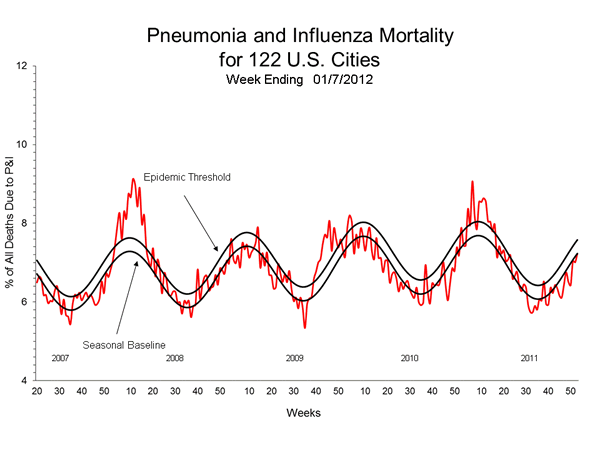
In just checking the CDC flu information, I found a significant variation below what is expected this time of year for the flu.  There are several possibilities as to why this is the case.  Of course the government is going to say it is the effectiveness of their programs of prevention that includes trying to get everyone vaccinated with the flu shot.  It is just normal statistical variation.  There are more people taking vitamin D and this has helped to reduce the total number of flu cases.  Here is the info for mortality and people seeking medical attention for flu symptoms:

Did you notice the dip on the last week of people seeking help for flu symptoms?  You would normally start to expect an ‘up-tick’ this time of year.  It is also significant to note that the death rate is below the normal control limits for this time of year.  This definitely means that something unusual is happening.

The bird flu of 2006 and the swine flu of 2009 turned out to be nothing but just over concern by the agencies that are involved in monitoring disease.  There were two op-eds that also caught my attention.  “Fear Gone Viral” by Wendy Orent in the LA Times reports that the US government has requested two studies not be published with methods for making the flu more transmittable in populations.  This has got the world health organizations in an uproar over how one country is able to control science.  Why are we studying how to make the flu more easily transmittable?

The other interesting story was about the ineffectiveness of Tamiflu and how the studies that were published on the use were falsified.  It does not surprise me in that we spent a billion dollars in 2006 to make this drug readily available.  It seems that there were fourteen unreported side effects.  The cure seems to have been more dangerous than the flu.  “No Magic Bullet on the Flu”  David Finkelstein LA Times

Magic Bullet for the Flu – Vitamin D!  – Pandemic Survivor

Knowing When to Eliminate the CPAP

It really gives me a chuckle when I read or hear a description of the three types of sleep apnea.  Obstructive sleep apnea – doctors do not have a clue as to what this means other than in their minds they think their patient is just a fatty and all its associations.  If you have sleep apnea the central nervous system has to be involved.  Certainly being obese will make the problem worse, but the origin of breath is from our automatic response to live as controlled by the nervous systems.  Apnea during sleep means that you stop breathing long enough to cause a drop in the amount of oxygen in your blood to a level that is too low to sustain the body functions.

When you sleep, the body functions slow down.  By design, carbon dioxide builds up in your blood.  Yes, that is the same stuff that your government wants to regulate to prevent ‘global warming’.  Stop breathing, you are heating the planet up – you dirty polluter.  Sorry, did not mean to get side tracked.  As your body relaxes, breath rate slows and the amount of blood oxygen saturation drops.  This saturation is measured from complete saturation of one hundred percent.  When awake this level of saturation is typically above ninety eight percent.  When you sleep, it is normal for the saturation to drop into the low nineties or ninety-one to ninety-three percent.  When the level drops below seventy percent, organ death begins to occur.

During an apnea event, the body begins to arouse because of the need for more oxygen.  It automatically causes your heart to start beating faster because the demand for oxygen has increased throughout the body.  This event is very similar to when you exert yourself and the demand from oxygen causes your heart rate to increase.  You may awake to find yourself gasping for breath and your heart is racing.  The body’s oxygen requirement gets satisfied and you relax again.

So how do you know if you have sleep apnea or if it has gotten better?  There are many levels of sleep disturbance.  Apnea is distinguished from the rest of the disorders by this drop in oxygen.  Do not get me wrong as I am not diminishing other sleep disorders.  Restful sleep is extremely important to allow our bodies to repair.  To determine if you have a disorder that includes apnea, a polysomnogram or sleep study is required.  This is when you are connected to monitoring that includes the various metrics of your body.

You have sleep apnea and are using a CPAP to control the amount of oxygen intake.  You increase your vitamin D and magnesium to allow your body to heal.  A simple method to determine if you are healing or if your blood has enough oxygen is a device called a pulse oximeter.  This device fits onto your hand or arm and measures both the heart rate and oxygen saturation.  Sometimes, you are asked to wear this device at home before or instead of a sleep test.  It is also a good device to help you decide if you can stop wearing your CPAP.

That is exactly what I did to determine if my sleep apnea had reversed itself.  I felt like I did not need the CPAP any longer, but my doctor insisted that if I stopped wearing it the issues would return.  I did not want the expense or nuisance of doing a sleep study.  I found a pulse oximeter and used it for three months while not wearing the CPAP.  I set the alarms to wake me when my oxygen rate dropped below eighty five percent or my heart rate got above 90 or below 50.  The use of this device at home should be discussed with your doctor.

In a recent review on availability, I was amazed at how easy these pulse oximeters are to obtain.  Six years ago, I had to order from a medical supply and the cost was over three hundred dollars.  Now these devices are available at drugs stores.  They range in price from about fifty dollars to two hundred fifty.  I noticed one popular brand and model was about eighty dollars at CVS to one hundred fifteen at Walmart.  It had enough memory to store events for up to seventy two hours with software and cable so that the data could be transferred to a computer.

The fear of not wearing the CPAP was gone.  I did not have to worry about whether my blood oxygen was dropping low enough to damage my organs.  That was great relief.  It was amazing as I went from dying with blood oxygen below seventy percent to no events without a CPAP.  My weight had not changed, my nervous system had healed.  I don’t need to know the mechanism of healing, just that I could sleep again without the CPAP.  Obstructive sleep apnea – indeed!  I love the sun!   -Pandemic Survivor